What’s Your Excuse for Not Scaling?
A straight-talk guide for founders who know they should be bigger by now.
Let me ask you something before you read another word.
What excuse are you using right now for not scaling your business?
Not the reason you give your board or your spouse. The excuse—the one you’ve repeated so often it sounds like a fact.
Last week, I got off a coaching call with a founder who has co-founded multiple companies. He was COO of a venture-backed tech business you’d recognize. He describes himself as a systems guy. On the side, he built a food brand with real customers. It’s stuck, and now he’s thinking about selling it.
His reason: “I don’t really like sales.”
A guy who builds systems for entire companies won’t build one for the thing that grows his own business. That’s not a sales problem. It’s an excuse problem. I’ve got one too, and I’ll show you mine.
Grab a pen. Write yours down before you keep reading.
Every excuse is a translation problem
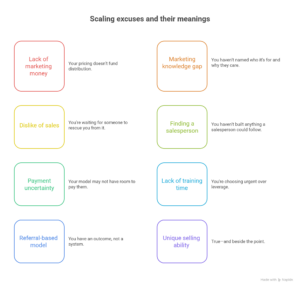
I put this question to the founders on our weekly CINERGY call. It took about ninety seconds to fill a whiteboard. Here’s what each excuse really means—and the first move that can help you get past it.
“I don’t have the money to market.”
-
What it really means: Your pricing doesn’t fund distribution.
-
First move: Know your true cost to deliver, then reprice.
“I don’t know how to market.”
-
What it really means: You haven’t named who it’s for and why they care.
-
First move: Write the emotional payoff for one buyer.
“I don’t really like sales.”
-
What it really means: You’re waiting for someone to rescue you from it.
-
First move: Write down your last three winning sales conversations.
“I can’t find a good salesperson.”
-
What it really means: You haven’t built anything a salesperson could follow.
-
First move: Document your sales process, step by step.
“I don’t know how to pay them.”
-
What it really means: Your model may not have room to pay them.
-
First move: Run the commission math before you hire.
“I don’t have time to train anybody.”
-
What it really means: You’re choosing urgent over leverage.
-
First move: Record your next five calls. That’s your training.
“We’re 100% referral-based.”
-
What it really means: You have an outcome, not a system.
-
First move: Ask for three more referrals this month.
“Nobody can sell it like I can.”
-
What it really means: True—and beside the point.
-
First move: Keep reading.
Every one of those came from someone who’s built something real. None of them are reasons. They’re stories. Three of them cost founders the most.
Excuse #1: “Nobody can sell it like I can”
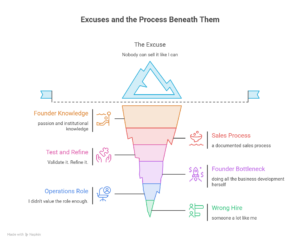
A founder I coach runs an 11-year-old agency and just launched a software product. She’s always been the top seller. She’s hired sales teams and paid for professional sales training. They never sold like she did, so she’s back to doing all the business development herself.
Here’s the hard truth: You’re right. Nobody will ever sell it like you.
You have the passion and institutional knowledge. You’ve lived every objection. That’s never going to transfer 100%.
But that was never the goal. The goal is to have someone who sells it 80% as well as you, using a process you can test. That frees you to be the rainmaker on the deals only you can close.
You can’t get to 80% if the process lives in your head. So the first excuse to kill isn’t “I can’t find good people.” It’s “I don’t have a documented sales process.”
Without a process:
-
Nobody can learn it.
-
You can’t test which step is breaking.
-
No partner has a reason to bring you into their clients’ businesses rather than do it themselves.
-
Nobody will ever buy your company.
That last one deserves its own line. Ask anyone who buys companies for a living: If the business falls apart when you step out, there’s no growth engine—and no buyer. Begin with the end in mind.
And don’t rush to hire as soon as the process is on paper. Run it yourself first. Validate it. Refine it. Bring in the team on version two or three, not version one.
My excuse
I’m not going to ask you to do this if I won’t. So here’s mine.
I’ve got a bald spot at $5 million. I’ve hit that ceiling three times in the last 15 years.
My excuse every time: “I don’t have the operations player to scale.” I’ve never successfully brought on an integrator to execute the vision. I’ve told that story so often it’s become part of my bio.
Now the honest part: That’s not bad luck. At least 90% of it is on me. I didn’t value the role enough. I didn’t hold it accountable enough. And more than once, I recruited someone a lot like me—which is exactly the wrong hire for a visionary.
See how that works? The excuse sounds like a hiring problem. It’s a me problem. Yours probably is too.
Excuse #2: “I’ll pay them when they bring it in”
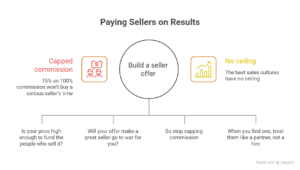
I can’t count how many founders tell me, “We’re happy to pay somebody on results.” Then I ask what those results pay: 15%.
Fifteen percent on 100% commission won’t buy a serious seller’s time. The math doesn’t math.
Two questions can help:
-
Is your price high enough to fund the people who sell it? If you don’t know your true cost to deliver, you can’t build in room for distribution.
-
Will your offer make a great seller go to war for you? Matching what they make today isn’t an offer. It’s a lateral move.
I learned this the hard way. Years ago, I pursued a sales and marketing guy I thought was brilliant. I got the board to approve a $120K base and a progressive commission I thought was aggressive: 7.5%, climbing to 12.5%. Then I found out what he was already making: over a million dollars a year. I couldn’t touch him.
The best sales cultures have no ceiling. Car dealerships figured this out long ago. So stop capping commission. Every capped seller I’ve known parks deals in the drawer until January. You’re paying your best people to stop selling in October.
One last thing: You can’t scale a business that needs a trained killer to sell it. There aren’t enough of them. When you find one, treat them like a partner, not a hire.
Excuse #3: “My buyers just don’t get it”
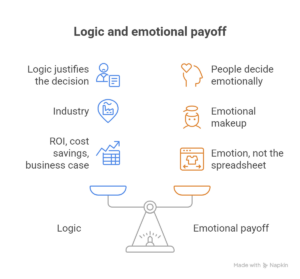
We all write out the ROI, the cost savings, and the business case.
Here’s my question: Have you written out the emotional payoff your buyer gets?
People decide emotionally and use logic to justify it. A founder in our network told me her ideal customer isn’t defined by industry. It’s defined by emotional makeup. Are they open to a new idea? Can they learn something without their ego getting in the way? Will taking you to their boss make them look smart—or put their job at risk?
If you can’t answer that, your process has a hole in it.
Let me tell you how I learned this. In my first sales job, I sold corrugated boxes in Elkhart, Indiana. I was brand new, fresh out of Michigan State, and hired alongside five Notre Dame grads.
I read How to Swim with the Sharks Without Being Eaten Alive and took its customer-profile questions dead seriously. I printed a workbook and filled it out for every buyer. Embarrassingly green.
One question asked about the buyer’s kids and their heroes. One buyer—the purchasing officer for the largest box consumer in three counties—had a son who loved baseball and worshipped Sammy Sosa.
I had a customer who made display cases for signed jerseys and traded with athletes. So, at my next monthly check-in, I showed up with a Sammy Sosa-signed jersey for that buyer’s son.
I got every order after that.
That’s not a bribe. That’s paying attention. Every business has a cheat code like that. It’s in the emotion, not the spreadsheet. Go find yours.
Your homework
You wrote your excuse down at the top. Now do three things with it:
-
Name the belief behind it. “I can’t find good salespeople” usually means “I haven’t built anything a salesperson could follow.”
-
Get a swim buddy. Not a coach—a peer. Someone you can call and say, “I just blew that call. Give me eight minutes to role-play it.” Role-playing is the most powerful sales training there is, and none of us do it enough.
-
Change one thing in your process this month. One question you’ll start asking in discovery, like “Who else is involved in this decision?” One step you’ll document. One payoff you’ll name.
This never stops. I’ve been selling and training salespeople for decades, and I’m changing our process right now because of what I’ve learned in the last three months.
There’s a reason rooms like ours work. You’re the crazy one in your family. You work for a demanding boss who doesn’t pay you enough: yourself. It helps to sit with people who make the same excuses you do—and who’ll call you on them.
That’s what we do at CINERGY Growth. If you want a room that holds you to it, book time with me.
Play Bigger Together.