The 5 Problems Between Sales and Marketing (And Why the Pursuit Team Always Wants to Throttle the Execution Team)
Every growing company eventually hits the same wall: the pursuit team and the execution team start acting like they work for two different businesses.
On one side, you’ve got sales and marketing — the pursuit team — living in a world where 94% of content gets ignored, 92% of emails never get opened, and close rates hover around 30% on a good day. Their world is messy, emotional, political, human. They’re trying to convince people who don’t know them, don’t trust them, and don’t have the time to care.
On the other side, you’ve got engineering, product, and delivery — the execution team — living in a universe defined by physics, specs, algorithms, project plans, and scope. Their world is clean, logical, predictable (unless someone screws with the scope).
Two different realities. Two different languages. Two different brains.
And when they don’t understand each other’s biases, they create friction that scales nothing.
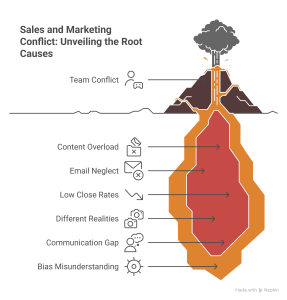
Here are the five biggest problems that consistently blow up alignment between pursuit and execution — and how you fix them if you actually want to scale a mid-market business.
1. The Certainty vs. Chaos Gap
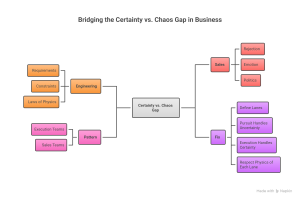
Engineering lives in certainty: requirements, constraints, laws of physics, cost structures, timelines.
Sales lives in chaos: rejection, emotion, politics, turf wars, buying committees, phantom budgets, and “we’re going a different direction.”
When engineering expec
ts certainty from sales, or sales expects chaos from engineering, you get resentment.
The pattern:
Execution teams think sales is making things up.
Sales teams think execution lives in a fantasy world.
The fix:
Define the lanes.
Pursuit handles uncertainty.
Execution handles certainty.
Respect the physics of each lane.
2. The Bias Blindness Problem
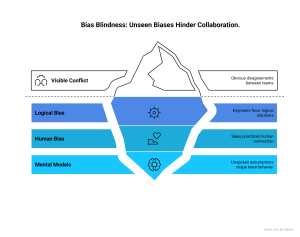
Engineers are biased toward what’s logical.
Sales is biased toward what’s human.
Those two are not the same.
Engineering believes:
“If the solution is good and the specs are tight, the customer will buy.”
Sales knows:
“The customer will buy when they trust us, feel understood, and believe we will make them look good politically.”
When you don’t surface these biases, they become invisible landmines.
The fix:
Force each side to articulate their mental models out loud.
Make the biases explicit so you can design around them instead of being run by them.
3. The “Throw It Over the Wall” Trap
Sales closes a deal.
Engineering gets it dumped on their desk.
Execution freaks out.
Sales says, “Don’t lose the customer.”
Engineering says, “Don’t sell vaporware.”
Round and round we go.
The problem:
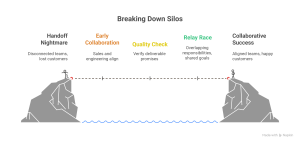
No early collaboration.
No quality check between what was sold and what can be delivered.
The fix
Stop treating sales → engineering as a handoff.
Treat it like a relay race.
Both runners overlap and run side-by-side for a stretch.
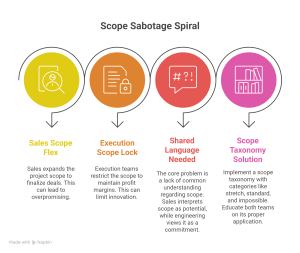
4. The Scope Sabotage Spiral
This is where companies go to die.
Sales flexes scope to close the deal.
Execution locks scope to protect margins.
Both are right.
Both are wrong.
Both sabotage each other.
The real issue:
No shared language of scope.
Sales hears “possibility.”
Engineering hears “promise.”
The fix:
Create a scope taxonomy — stretch, standard, impossible — and teach both teams how to use it.
This alone will prevent 80% of your internal fights.
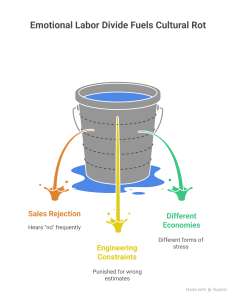
5. The Emotional Labor Divide
Sales lives in rejection.
Engineering lives in constraints.
Sales hears no 50 times a week.
Engineering gets punished for one wrong estimate.
Different emotional economies.
Different forms of stress.
Different versions of “hard.”
When the pursuit team feels unappreciated and the execution team feels overextended, you get cultural rot.
The fix:
Normalize the emotional reality of both roles.
Celebrate different types of difficulty.
Stop comparing pain — integrate it.
Why All This Matters
Mid-market companies die when pursuit and execution blend into one sloppy mess of crossed responsibilities and unspoken resentments.
They scale when both sides:
-
stay in their lanes,
-
know their role in the system,
-
respect the physics of the other side, and
-
build a shared operating rhythm instead of lobbing grenades over the wall.
When you get the lanes right, alignment becomes automatic.
When you don’t, every project becomes a knife fight.
Now looping back to you:
Where do you see this friction the most right now — pursuit overstepping execution, or execution bottlenecking pursuit?