Do You Want to Be Great or Do You Want to Be Right?
(Because I Promise You — Those Two Things Are Rarely the Same)
Let me tell you what happened at 3 AM last week.
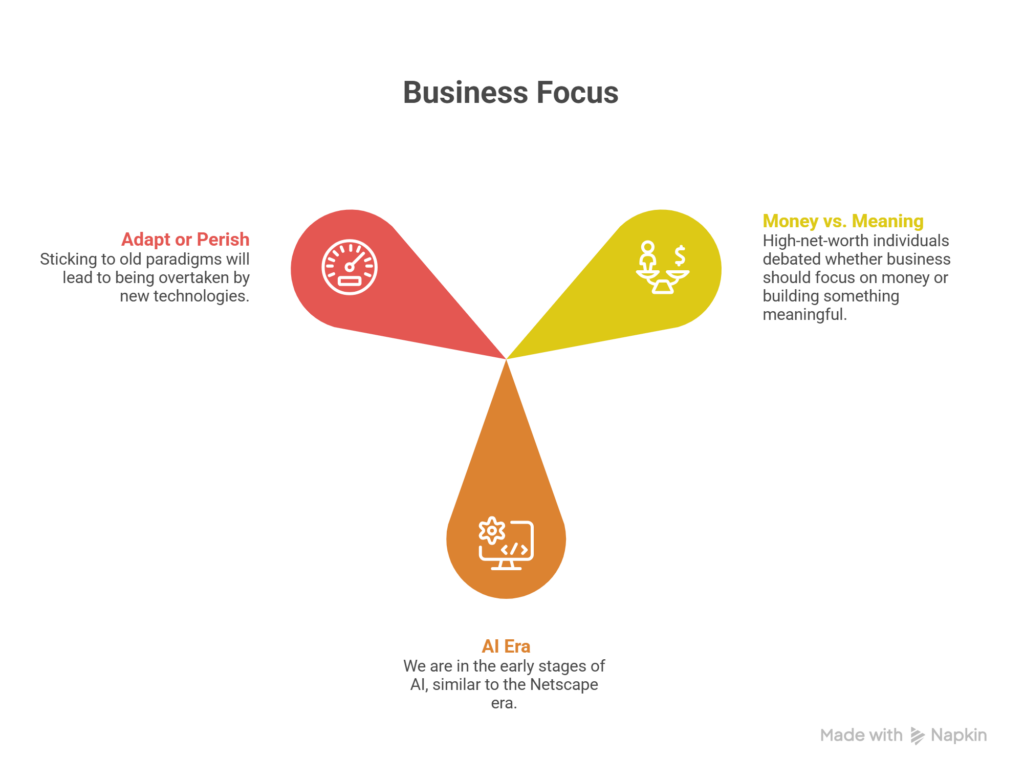
Five high-net-worth individuals. A team that’s been together for two years. People who’ve committed time, money, and energy to a shared mission.
And they spent five hours in a circular s*** storm over whether a business should be about money or about building something meaningful.
Five hours.
I’m 53 years old. I thought I knew what business was. And watching that argument unfold — watching brilliant people go sideways over an identity question instead of a purpose question — changed something in me.
Because here’s the truth nobody says out loud:
You’re living in the Netscape era of AI. Version 1.0. The very beginning. And if you’re still arguing about the same paradigms that worked 10 years ago, you’re going to get run over by the speed of what’s coming.
So let’s talk about it.
The False Choice That’s Destroying Teams
Money or meaning. Profit or purpose. Great or right.
I hear this everywhere. I watched it tear a room apart at 3 AM. And it drives me insane — because why does it have to be one or the other?
Here’s what I told that team:
You have to create tremendous value. And you have to be profitable — because without profit, you can’t fund the continued creation of value. The speed of change you’re about to face in the next five years requires capital. It requires resources. It requires the ability to move fast.
You can’t move fast if you’re broke. You can’t change the world if you can’t keep the lights on.
But here’s what’s more interesting to me than the money question:
Why do smart people get rolled into the identity question instead of the purpose question?
Because they stop playing chess. They stop playing checkers. They’re playing solitaire — just flipping cards and seeing what happens, with zero strategy and zero engagement with the people around them.
And solitaire doesn’t scale.

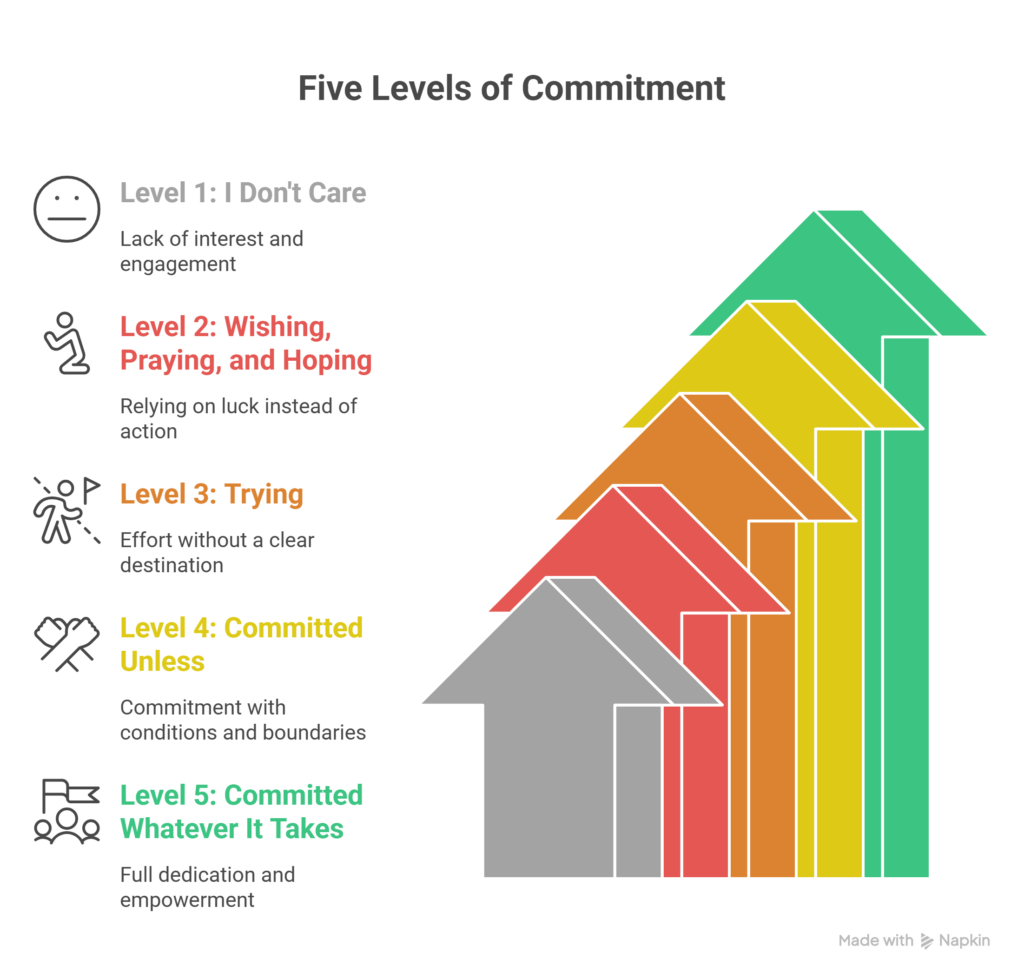
The Five Levels of Commitment (And Why 1 Through 3 Are Sabotage)
Write down the numbers 1 through 5. I’m serious.
Because everything in your business — every team, every partnership, every client relationship — lives somewhere on this list.
Level 1: I Don’t Care.
Simple. If you don’t care, stop spending time, energy, or money on it. Move on.
Level 2: Wishing, Praying, and Hoping.
Here’s the one that kills me. You know what wishing and praying and hoping actually is?
The beginning of sabotage.
Think about it. If I hand you a Rubik’s Cube right now and you have no idea how to solve it — the average person takes almost two million days to figure it out alone. Two million days.
But find someone who knows how to solve it? Twenty minutes. Maybe less.
How many of you are spending two million days trying to figure something out on your own — refusing to hire the expert, refusing to invest in the solution — because you’re stuck wishing it would just work itself out?
That’s not commitment. That’s sabotage with an optimistic face.
Level 3: Trying.
Does it take more energy to try to do something, or to commit to doing it?
Try. Every time.
Because when you try, you’re in motion without destination. I used to do this exercise on stage — I’d go to the biggest person in the room and say “Try to pull this book out of my hand.” And we’d stand there locked for ten, twenty minutes. Nobody ever made it happen. Because trying means you’ve already accepted the possibility of failure.
Commit to pulling it out of my hand? It’s gone in two seconds.
Levels 1, 2, and 3 are self-sabotage. Full stop.
Level 4: Committed Unless.
I’m committed unless it costs too much. I’m committed unless they don’t agree with me politically. I’m committed unless it takes time away from my family. I’m committed unless it gets hard.
Some “committed unless” is healthy — you need boundaries. But if you’ve already agreed to be on a team, already invested in a shared mission, already committed to people who are counting on you?
“Committed unless” is just cowardice with conditions.
Level 5: Committed Whatever It Takes. COWIT.
This is where empowerment lives.
This is where the businesses that sell for 12x instead of 3x live. This is where relationships that actually compound live. This is where you stop treading water and start building.
Burn the ships. Cortez knew what he was doing.
The Paradigm Problem (And Why You Need to Unknow What You Know)
Here’s my honest confession:
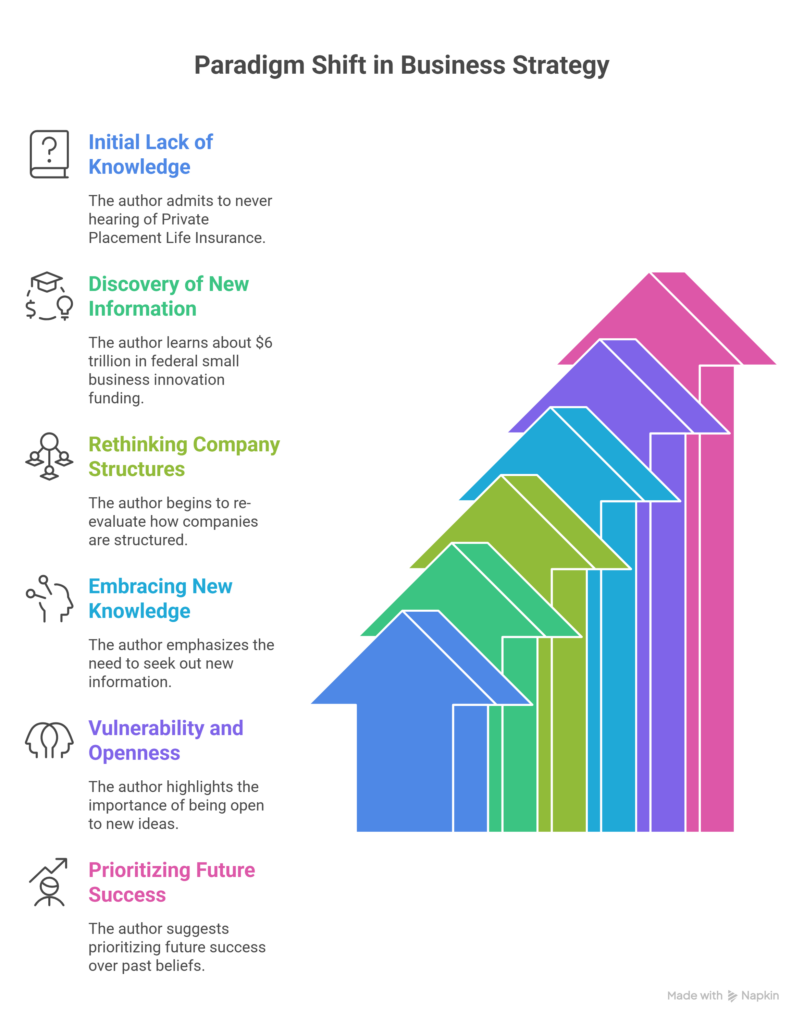
I had never heard of Private Placement Life Insurance before Harvey explained it to me. Never. And I’ve been in business my whole adult life.
And now I’m rethinking how we structure every company we work with.
Three years ago, I didn’t know there was $6 trillion in federal small business innovation funding sitting there. Didn’t even know it existed. Today it’s one of the most powerful plays I’m making for the companies in our network.
The point?
The speed at which business is changing right now requires you to unknow what you think you know.
We are at Netscape. Version 1.0 of AI. The first internet browser. And most people are still arguing about dial-up vs. cable.
The companies that win in the next five years aren’t going to be the ones who doubled down on what worked last decade. They’re going to be the ones who were hungry for net new knowledge — who got out of their echo chambers, who listened to the Harvey Feinbergs of the world, who let their paradigm get shattered by someone they just met on a Zoom call.
That requires vulnerability.
It requires the ability to say: “I don’t know what I think I know.”
The Question I’m Leaving You With
Are you playing chess or checkers?
Are you playing long-term value creation, or are you just flipping cards?
Are you building a business or building a bigger boat?
And most importantly:
Do you want to be great, or do you want to be right?
Because here’s what I’ve learned at 53, watching brilliant people go sideways at 3 AM over a question that was never really about money:
The ones who are great? They changed their mind. They let themselves be changed. They got to a better answer together instead of protecting the answer they walked in with.
The ones who were right? They went home. Alone. With their opinion intact.
Pick one.
